UK Publishes ISSA (UK) 5000 to Strengthen Sustainability Assurance Practices
As sustainability reporting requirements continue to evolve, organisations are paying closer attention to the quality and reliability of the information they disclose. In this context, the Financial Reporting Council has published ISSA (UK) 5000, a standard setting out general requirements for assurance engagements on sustainability information.
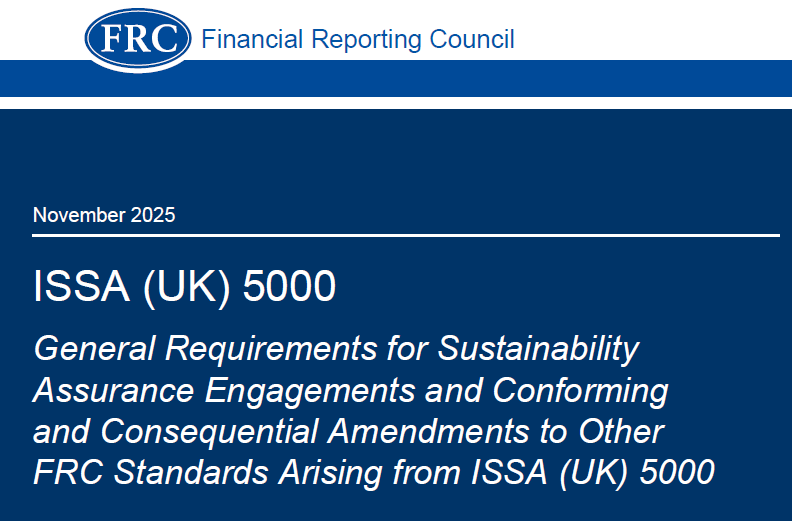
The Financial Reporting Council (FRC) has issued ISSA (UK) 5000 “General Requirements for Sustainability Assurance Engagements”, establishing a comprehensive framework for assurance of sustainability information. According to the regulator’s announcement, the standard aims to support consistent assurance practices and increase confidence in sustainability disclosures through strengthened quality requirements.
Scope and Foundations of the Standard
ISSA (UK) 5000 applies to all assurance engagements on sustainability information, covering environmental, social, governance and other sustainability-related matters. Sustainability information results from measuring or evaluating sustainability matters against applicable criteria, and may include disclosures on risks, opportunities, metrics or qualitative statements. The standard applies to both reasonable and limited assurance engagements and requires practitioners to assess the suitability, relevance and reliability of the criteria used.
Key Assurance Requirements
The standard outlines detailed expectations for the conduct of assurance engagements. It emphasises the use of professional scepticism and professional judgment, as well as the need to obtain sufficient appropriate evidence. ISSA (UK) 5000 includes specific requirements for planning procedures, identifying and assessing risks of material misstatement and determining materiality for both qualitative and quantitative disclosures. Practitioners must evaluate the entity’s process for identifying sustainability information and consider whether the reporting boundary aligns with the applicable criteria.
The standard also introduces guidance on the use of the work of other practitioners and experts, outlining conditions under which such work may be relied upon. Requirements for documentation, communication with management and those charged with governance, and the evaluation of misstatements are set out in detail.
Quality Management and Ethical Expectations
ISSA (UK) 5000 is built on the premise that the engagement team operates within a system of quality management consistent with ISQM (UK) 1. Practitioners must comply with the ethical requirements of the IESBA Code, including independence rules. The engagement leader is responsible for ensuring that the team possesses both sustainability competence and assurance skills, and that appropriate resources are allocated to the engagement.
These expectations reflect the increasing complexity of sustainability matters and the need for multidisciplinary expertise in assurance engagements.
Effective Date and Practical Implications
The standard is effective for sustainability information reported for periods beginning on or after 15 December 2026, with earlier application permitted. Entities preparing for assurance are expected to align their internal control systems, reporting processes and application of criteria with the requirements of ISSA (UK) 5000. The focus on suitable criteria, defined reporting boundaries and documented evidence processes may drive enhancements in how organisations structure their sustainability reporting.
Significance for the UK Sustainability Reporting Landscape
The introduction of ISSA (UK) 5000 provides a unified assurance framework tailored to sustainability information. By setting expectations for practitioners and aligning assurance practices with internationally recognised principles, the standard supports the development of more reliable and decision‑useful sustainability disclosures. It establishes a foundation for credible assurance outcomes and strengthens the integrity of the UK’s sustainability reporting environment.