Proposed Amendments to ESRS: Developments from the 2025 Due Process Discussions
As the amended ESRS drafts progress through EFRAG’s due process, their evolving content offers valuable indications of what undertakings may expect from future reporting obligations. The discussions held in late November provide important signals about the scope and timing of upcoming changes.
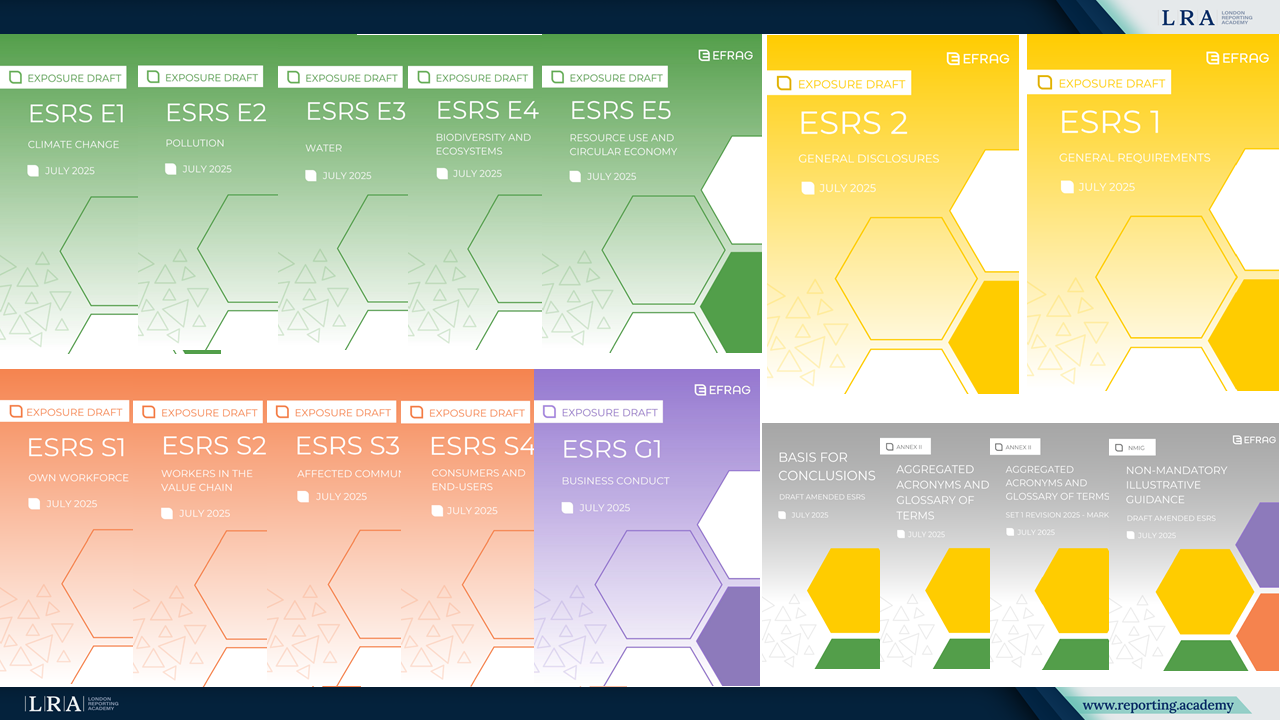
The European Sustainability Reporting Standards (ESRS) are progressing through an important transition stage under the Corporate Sustainability Reporting Directive (CSRD). EFRAG published the Amended ESRS Exposure Drafts on 31 July 2025 and opened a public consultation process. These drafts introduce revisions to the 2023 ESRS set and reflect the simplification mandate issued by the European Commission. The amended standards remain drafts while undergoing EFRAG’s due process conducted by the Sustainability Reporting Board (SRB) and the Sustainability Reporting Technical Expert Group (SR TEG). Only after the delivery of technical advice and the subsequent adoption of a Delegated Act will the amendments become legally binding.
The proposed changes respond to concerns raised during the first CSRD application cycle. The revisions aim to strengthen clarity, reduce unnecessary complexity and support a more proportionate approach to sustainability disclosures.
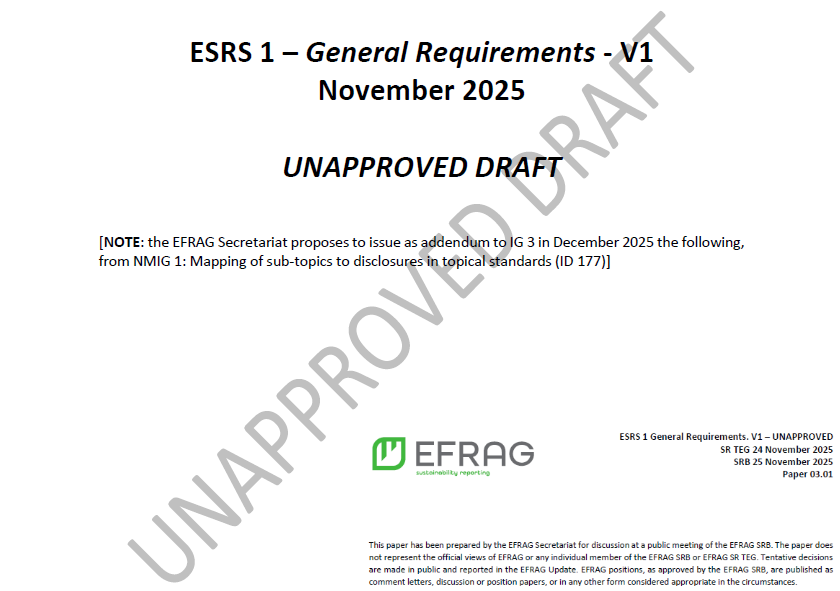
Key Revisions within ESRS 1
The updated version of ESRS 1 introduces a clearer structure for cross-cutting requirements. The draft consolidates definitions and concepts relating to reporting boundaries, materiality and interactions between sustainability topics. Revised sections provide expanded expectations concerning the inclusion of own operations upstream and downstream value chain information and joint operations. The draft clarifies how undertakings should apply estimates, manage uncertainty and describe data limitations.
The amendments refine the interaction between the sustainability reporting boundary and financial consolidation. The draft explains when differences may arise and how undertakings should disclose the reasons for any deviation. This clarification is intended to reduce inconsistencies in the application of reporting boundaries.
Transitional Provisions and Wave Classifications
The amended ESRS 1 reorganises transitional provisions and clarifies how phase-in options operate.
Paragraph 130 introduces a formal distinction between “wave-one” undertakings and other undertakings within the scope of ESRS. In the amended text, “wave-one” undertakings are described as entities that were meant to publish sustainability information for the first time in respect of financial year 2024, regardless of whether the CSRD has already been transposed into national law in the relevant Member State.
For “wave-one” undertakings, the draft allows the following omissions in their sustainability statements:
- All disclosure requirements in ESRS E4 Biodiversity and Ecosystems ESRS S2 Workers in the Value Chain ESRS S3 Affected Communities and ESRS S4 Consumers and End-users for financial year 2026.
- All information on anticipated financial effects required by ESRS 2 paragraph 27 and by ESRS E1 (Disclosure requirement E1-11 Anticipated financial effects from material physical and transition risks and potential climate-related opportunities) for financial year 2026.
- Quantitative information on anticipated financial effects required by ESRS 2 paragraph 27 and ESRS E1 (Disclosure requirement E1-11 Anticipated financial effects from material physical and transition risks and potential climate-related opportunities) for financial years 2027, 2028 and 2029.
- Quantitative information on substances of concern and substances (SoC) of very high concern required by ESRS E2 (Disclosure requirement E2-5 Substances of concern and substances of very high concern) for financial years 2026, 2027, 2028 and 2029.
- For ESRS S1 Own workforce in financial year 2026 the following disclosure requirements may be omitted:
- S1-6 Characteristics of non-employee workers,
- S1-7 Collective bargaining coverage and social dialogue for non-EEA countries
- S1-10 Social protection
- S1-11 Persons with disabilities
- S1-12 Training and skills development
- S1-13 Health and safety metrics in paragraph 40(d) and 40(e) together with the non-employee datapoints
- S1-14 Work-life balance metrics.
Other undertakings that are not in wave-one may omit the following for the first three years of preparing their sustainability statement:
- All Disclosure requirements in ESRS E4, ESRS S2, ESRS S3 and ESRS S4.
- Quantitative information on anticipated financial effects required by ESRS 2 paragraph 27 and by ESRS E1 disclosure requirement E1-11.
- Quantitative information related to substances of concern and substances of very high concern required by ESRS E2 Disclosure requirement E2-5.
- The same ESRS S1 disclosure requirements listed for “wave-one” undertakings namely S1-6, S1-7, S1-10, S1-11, S1-12, S1-13 datapoints in paragraph 40(d) and 40(e) including non-employee datapoints and S1-14.
In addition, the transitional chapter confirms that in the first year of ESRS application undertakings are not required to present comparative information for prior periods and that for the first three years undertakings may limit value chain information where data is not yet available provided they explain data gaps and plans to improve coverage. For undertakings that qualify as Article 5(2) entities (wave-one), the value chain relief cannot be used after financial year 2026.
Even where these disclosures are phased in, undertakings are still required to carry out a double materiality assessment for each topic. If a topic is material, they must provide at least high level narrative disclosures that describe related policies, actions, metrics and targets in line with ESRS.
Double Materiality and Due Diligence Clarifications
The revised ESRS 1 strengthens the link between double materiality assessments and sustainability due diligence. Preparers are expected to explain methodologies, data sources, sector analysis and external inputs that inform the identification of impacts, risks and opportunities. The amendments highlight the need to describe areas of heightened risk including those associated with specific business relationships activities or geographies.
The draft explicitly discourages generic or standardised descriptions. Instead preparers are expected to provide specific concise and decision-useful information tailored to the undertaking’s actual circumstances.
Revisions to ESRS 2 General Disclosures
The amended ESRS 2 introduces a more coherent structure for disclosure requirements. The section on the basis for preparation now provides clearer guidance on available reliefs and how undertakings must report their application.
Notable changes relate to anticipated financial effects. The draft outlines the circumstances in which quantitative information may be omitted and clarifies which qualitative information remains mandatory. This adjustment reflects the recognition that early stage estimates often involve high uncertainty.
General disclosure requirements for policies actions metrics and targets now follow a unified drafting approach. This supports consistency across topical standards and ensures alignment between narrative disclosures and the results of the materiality assessment.
Adjustments within Environmental Standards
The environmental standards E1 to E5 have been reorganised for improved clarity. Methodological detail has been placed into application guidance. The amendments also emphasise the use of scientific evidence where applicable and clarify the treatment of value chain metrics. Datapoints derived from other EU legislation are integrated consistently through the mapping provided in ESRS 2.
Updates to Social Standards S1 to S4
The social standards have been revised to align terminology and structure with the cross-cutting requirements. Definitions of affected stakeholder groups and descriptions of due diligence links have been harmonised with ESRS 1. Several datapoints have been consolidated to reduce the reporting burden. Transitional provisions remain aligned with the broader phase-in measures applicable to wave-one and other undertakings.
Developments in Business Conduct Disclosures
The business conduct standard ESRS G1 has been reorganised to separate mandatory requirements from illustrative guidance. The amendments clarify expectations concerning anti-corruption procedures whistle-blower protection political engagement and payment practices. The draft also provides more detailed guidance regarding the identification of roles exposed to conduct risks and explanations of confirmed incidents.
Conclusion
The proposed amendments published in July 2025 represent a significant step in the refinement of the ESRS framework. They reflect feedback from the first reporting cycle and seek to enhance clarity, proportionality and coherence. ESRS 2 and the topical standards incorporate structural improvements and interact with the transitional measures set out in ESRS 1. As due process discussions continue and consultation feedback is evaluated the final Delegated Act will determine which amendments will become mandatory for future reporting periods.