ISSB Standards at the Two-Year Mark: Developments and Reporting Implications
The latest resource paper from Governance & Accountability Institute, Inc. (G&A) provides an updated view on how the ISSB Standards are shaping corporate sustainability reporting as their implementation continues to expand. Its insights help clarify the role of IFRS S1 and IFRS S2 within the evolving global disclosure landscape.
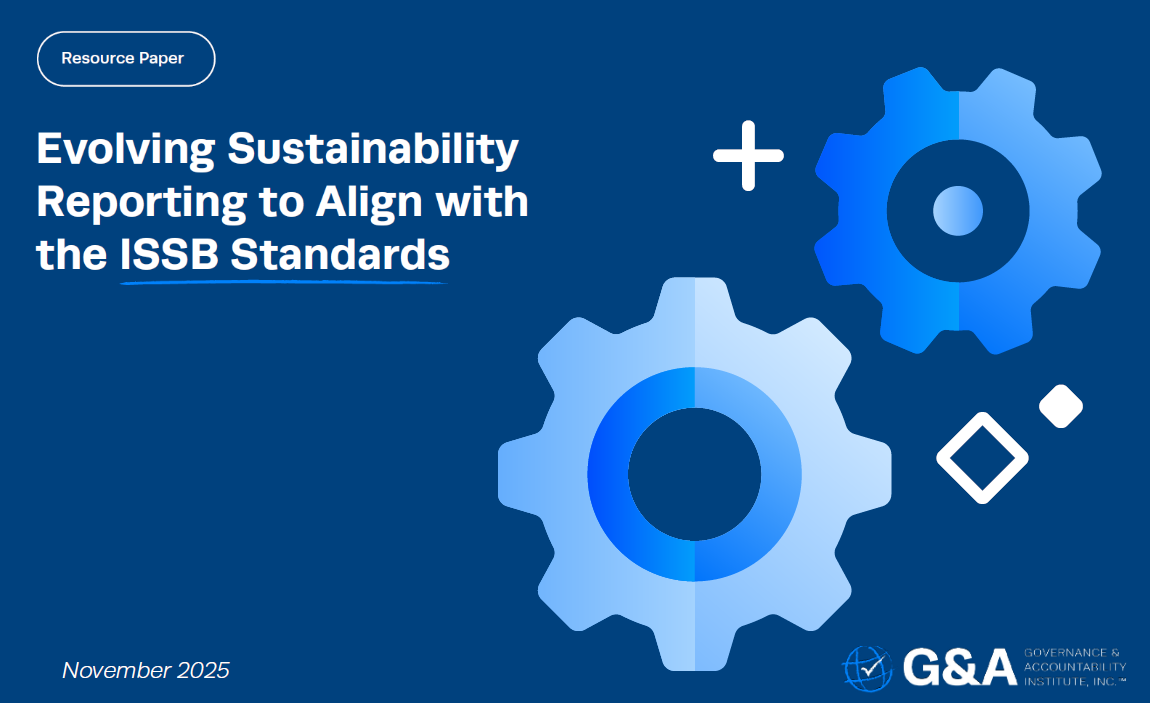
As the two-year milestone since the ISSB Standards became effective in January 2024 approaches, corporate reporters are reassessing how sustainability information is structured and presented. This overview draws on the resource paper published last week by Governance & Accountability Institute, Inc. (G&A), a corporate sustainability consulting and research firm, which examines recent developments in the application of IFRS S1 and IFRS S2 and the broader context of evolving sustainability reporting.
From Earlier Frameworks to a Global Baseline
The ISSB Standards represent an evolution of earlier sustainability initiatives rather than a departure from them. The Standards build on the work of the Climate Disclosure Standards Board (CDSB), the Task Force on Climate-related Financial Disclosures (TCFD) and the Sustainability Accounting Standards Board (SASB). IFRS S1 requires companies to consider SASB Standards relevant to their industry when determining appropriate metrics, while IFRS S2 fully incorporates the TCFD Recommendations across governance, strategy, risk management and metrics and targets.
Endorsement by the International Organization of Securities Commissions (IOSCO) reflects growing regulatory interest in a globally consistent sustainability disclosure framework. As noted in the report, some jurisdictions are progressing towards mandatory alignment, and others, including California through SB261, reference IFRS S2 and TCFD as accepted bases for climate-related disclosure.
Core Concepts Guiding Application of IFRS S1 and IFRS S2
G&A highlights several concepts that shape how the ISSB Standards are intended to operate in practice. IFRS S1 and IFRS S2 are described as fair presentation standards. Companies are expected to disclose sustainability information that could reasonably affect their prospects and to present such information faithfully, neutrally and comprehensively. Where the Standards do not explicitly cover a relevant matter, additional information may be required to ensure a complete understanding of sustainability-related risks and opportunities.
Connectivity between sustainability information and financial statements is a central feature. Reporting is prepared for the same boundary as financial disclosures and should demonstrate how sustainability-related factors influence financial position, performance and cash flows. The Standards are also designed with interoperability in mind. The G&A paper notes ongoing collaboration between the ISSB, the Global Sustainability Standards Board responsible for the GRI Standards, and EFRAG, which oversees the European Sustainability Reporting Standards, aimed at strengthening alignment and easing combined use.
Transition Pathways and the Continued Role of TCFD
The report emphasises that many organisations are considering how to phase in the ISSB Standards. Although IFRS S1 and IFRS S2 are intended to operate together, companies may initially have more established processes for climate-related reporting. To support early adoption, IFRS S1 includes transition relief permitting companies in their first year of reporting to disclose only climate-related information in line with IFRS S2.
TCFD continues to serve as a practical entry point for many preparers. G&A notes that IFRS S2 follows the same four-pillar structure as TCFD while providing more detailed disclosures, including requirements on scenario analysis, Scope 3 emissions and transition planning. For organisations with existing TCFD reports, the transition to IFRS S2 may therefore represent a natural continuation of established practice.
Looking Ahead for Corporate Reporters
The developments outlined in the G&A paper underscore that adopting the ISSB Standards is both a technical and strategic shift. By applying a financial materiality lens, IFRS S1 and IFRS S2 aim to support decision-useful sustainability disclosures that integrate more closely with risk management and financial planning.
For companies preparing GRI-based or TCFD-aligned reports, the ISSB Standards provide a structured approach to enhance comparability and respond to emerging regulatory expectations. As interoperability with ESRS and GRI continues to progress and jurisdictions refine their disclosure requirements, alignment with IFRS S1 and IFRS S2 is expected to remain an important reference point for sustainability reporting.