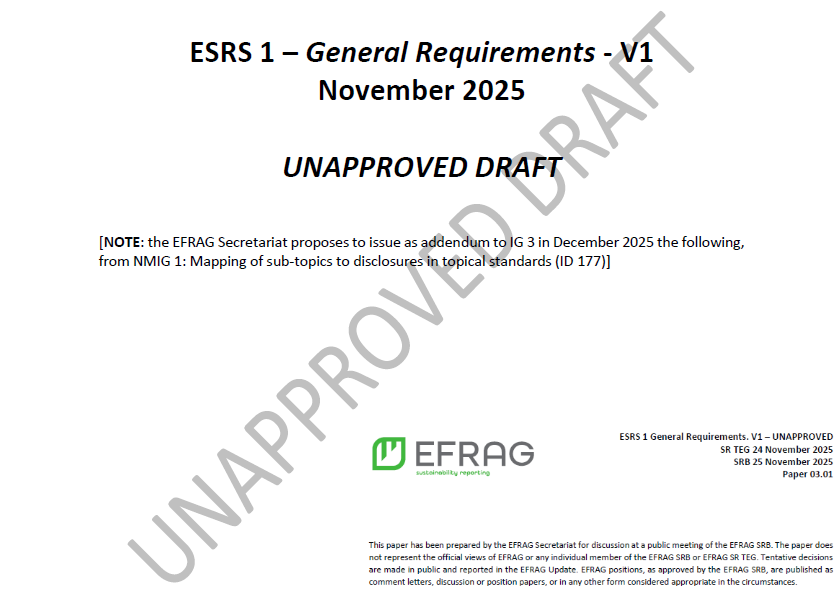
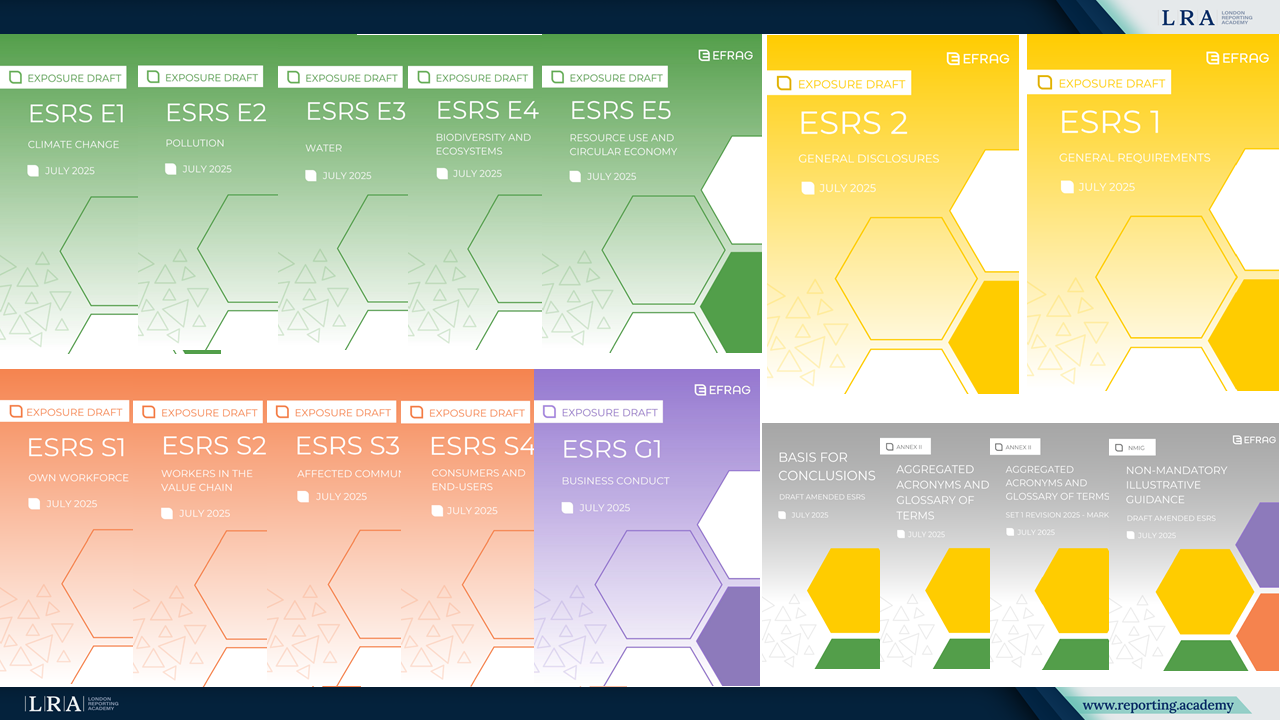
Developments in the Draft Simplified ESRS Following EFRAG’s Technical Advice
The European Sustainability Reporting Standards are now being refined through a simplified draft set. The proposed changes adjust the level of detail, documentation and data requirements, while keeping the core structure and objectives of ESRS unchanged.
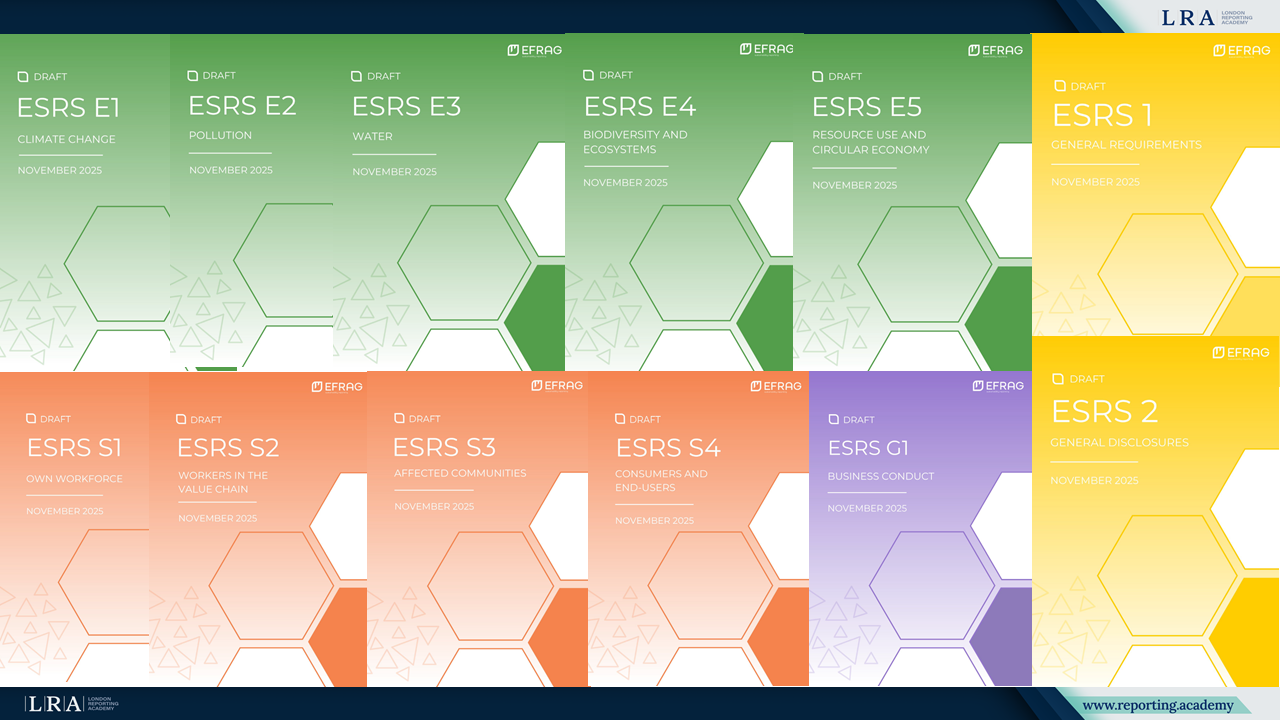
EFRAG has submitted its technical advice on the draft Simplified European Sustainability Reporting Standards (ESRS) to the European Commission. The advice draws on lessons from the first application of ESRS by "wave-one" reporters in 2024 and on evidence gathered through the public consultation, which received input from more than 700 respondents.
The Simplified ESRS set retains the cross-cutting standards ESRS 1 General Requirements and ESRS 2 General Disclosures, together with environmental, social and governance topical standards, but restructures and condenses requirements to make implementation more proportionate, easier to understand and more closely aligned with practical reporting needs.
Key Simplifications and Quantitative Reductions
According to the official factsheet, the draft Simplified ESRS introduce a substantial narrowing of required datapoints and a stronger focus on useful information. The changes include:
- 61% reduction in required datapoints when material;
- deletion of all voluntary disclosures;
- shorter and clearer standards with streamlined drafting and application guidance;
- stronger filter on relevance and fair presentation, aligned with IFRS S1;
- removal of the systematic preference for direct value chain data.
The factsheet also highlights improved interoperability with ISSB, including alignment on selected shared disclosures, an adjusted greenhouse gas boundary and provisions for anticipated financial effects.
Reliefs and phase-in mechanisms are strengthened, with particular attention to difficult disclosures and value chain metrics. Several reliefs are open-ended but accompanied by transparency expectations and an assumption that coverage will increase over time.
Fair Presentation and Simplified Double Materiality
The revised ESRS 1 emphasises fair presentation as the overarching objective of the sustainability statement. Undertakings are required to present a complete, neutral and accurate depiction of material impacts, risks and opportunities and of how these are managed across governance, strategy including financial effects, policies and actions, and metrics and targets.
Information materiality is defined at the level of users of general-purpose financial reports and sustainability statements. If a datapoint prescribed in a disclosure requirement is not material, it does not need to be reported. Undertakings can use a top-down, bottom-up or combined approach to double materiality and may rely on qualitative analysis without exhaustive quantitative scoring where this is sufficient to support a reasonable conclusion.
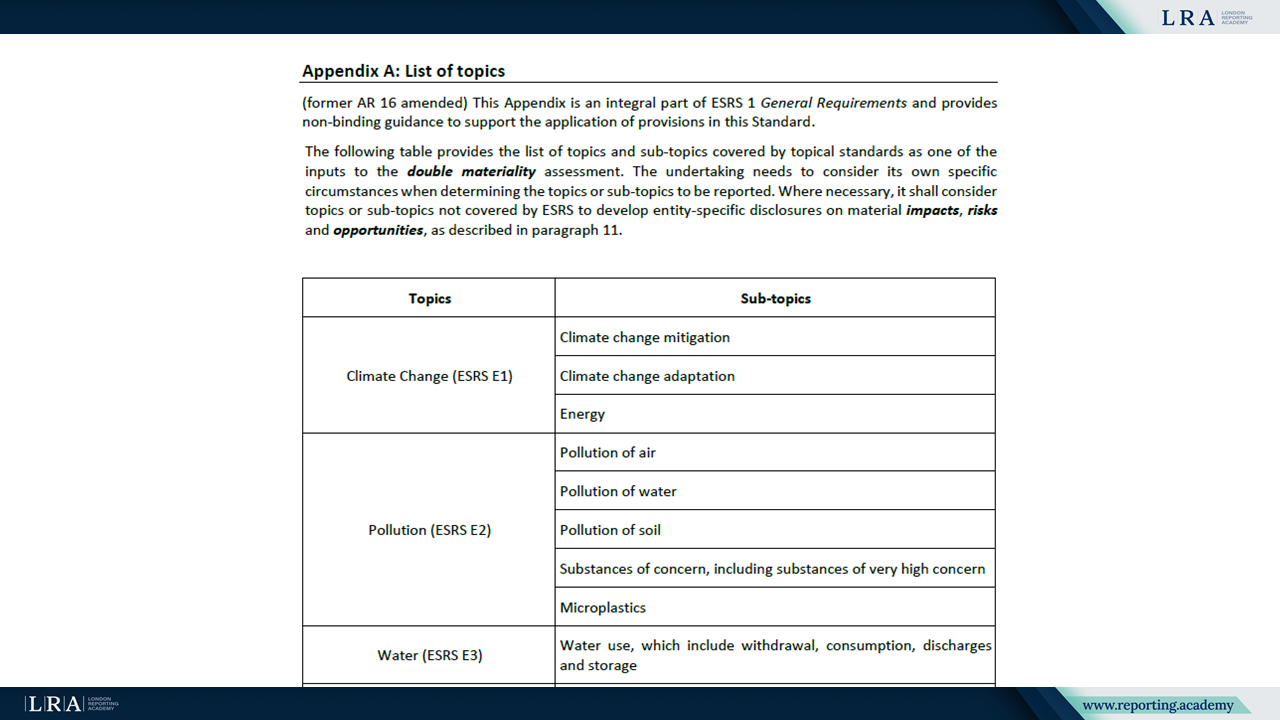
Source: Draft ESRS 1 – General Requirements
Guidance on impact materiality clarifies the use of scale, scope and irremediable character, the role of affected stakeholder engagement and the treatment of prevention, mitigation and remediation. Positive impacts are assessed separately and are not netted against negative impacts.
Reporting Boundaries and Value Chain Information
ESRS 1 clarifies the relationship between own operations and value chain information. The sustainability statement is prepared for the same reporting undertaking as the financial statements, including consolidated groups. Own operations generally follow the financial consolidation perimeter, subject to specific provisions for leasing, long-term employee benefit schemes and non-material subsidiaries.
Material impacts, risks and opportunities connected through business relationships in the upstream and downstream value chain must be reported to the extent necessary to meet the qualitative characteristics of information. Undertakings may:
- use estimates based on internal and external sources, including sector data and proxies;
- avoid exhaustive information collection across all value chain actors;
- classify investments in associates and joint ventures as business relationships for value chain purposes.
New reliefs permit exclusion of certain activities from metric calculations where they are not significant drivers of impacts, and allow partial reporting scopes where only part of the value chain can currently be covered without undue cost or effort, with a stated expectation of improved coverage over time.
Transitional Provisions for “Wave-one” Undertakings
Transitional provisions for “wave-one” undertakings, as described in ESRS 1 Chapter 10, apply from the first financial year in which an undertaking is required to prepare and publish a sustainability statement. These undertakings were scheduled to report on sustainability for the first time for financial year 2024 and are defined by reference to Article 5(2) of the CSRD.
For financial year 2024 “wave-one” undertakings are not required to present comparative information under Chapter 7.1. In addition, they may apply the following reliefs:
- for financial years prior to 2027, omit all disclosure requirements in ESRS E4 Biodiversity and Ecosystems, ESRS S2 Workers in the Value Chain, ESRS S3 Affected Communities and ESRS S4 Consumers and End-users together with the social datapoints S1-6, S1-7 for non-EEA countries, S1-10, S1-11, S1-12, S1-13 paragraph 40(d)(e) including non-employee datapoints and S1-14;
- for financial years prior to 2027, omit information on anticipated financial effects required by ESRS 2 paragraph 27 and ESRS E1-11, except for the specified qualitative paragraphs;
- for financial years prior to 2030, omit the related quantitative information on anticipated financial effects and quantitative information on substances of concern under ESRS E2-5.
Adjustments to ESRS 2 General Disclosures
Within ESRS 2, several disclosure areas are simplified. Business model and value chain information is less granular, stakeholder engagement requirements are streamlined and governance disclosures are consolidated. The general disclosure requirements on policies, actions, metrics and targets are refocused to remove overlap with topical standards and to support cohesive and concise reporting.
Anticipated financial effects remain within the scope of disclosures on strategy and resilience. Quantitative information is subject to additional reliefs and phased in up to 2029, reflecting the inherent uncertainty of early stage estimates and the need for alignment with IFRS S1.
Environmental Standards E1 to E5
Changes in the environmental standards aim to increase clarity and reduce complexity. The revisions streamline climate related disclosures in ESRS E1 by removing selected datapoints, adjusting greenhouse gas boundaries and providing additional flexibility in target setting. ESRS E2 simplifies pollution related requirements through restructured guidance, differentiated treatment of microplastics and a phased in approach for substances of concern. ESRS E3 refines water related disclosures by clarifying core concepts and consolidating metrics. ESRS E4 and ESRS E5 strengthen biodiversity and resource use reporting by reorganising metrics, consolidating location specific information and introducing the defined concept of key material.
Social Standards S1 to S4
The social standards S1 to S4 have been revised to reduce datapoint volumes and align structure with cross cutting requirements. Human rights policy content is centralised in ESRS 2. Engagement, channels and remedy requirements are merged and simplified, and the definition of human rights incidents has been updated to focus on substantiated cases involving internationally recognised human rights.
Within ESRS S1 Own workforce, the revisions aim to improve proportionality by simplifying country-level breakdowns, reducing non-employee disclosures to a single essential datapoint, removing age distribution from diversity metrics, refining adequate wages methodology with reference to ILO living wage principles and narrowing social protection and work-life balance disclosures to core elements.
Governance Disclosures in ESRS G1
ESRS G1 on business conduct is reorganised to mirror the policies, actions and targets structure and removes granular datapoints. The focus is on core expectations for anti-corruption and bribery procedures, whistle-blower protection, supplier relationships, political engagement and lobbying activities and payment practices, including guidance on late payments to small and medium sized enterprises. Metrics on incidents of corruption and bribery and on political influence are simplified, while the scope of convictions, fines and sanctions is clarified.
Next Steps for Undertakings
The European Commission will now develop a Delegated Act to revise the first ESRS set using EFRAG’s technical advice. EFRAG plans to support implementation through guidance, questions and answers and educational materials, including the ESRS Knowledge Hub, which has now been launched as a central navigation tool for the standards.
For undertakings in scope of CSRD this transition signals a move towards more focused and principles based sustainability reporting. While datapoints are reduced and reliefs expanded, the requirements on fair presentation, double materiality and connectivity with financial information remain central to the future ESRS framework.
Supporting Materials
Explore the draft Simplified ESRS with all source documents via the links below.
Cross-Cutting Standards
Environmental Standards
E4 – Biodiversity & Ecosystems
E5 – Resource Use & Circular Economy
Social Standards
S2 – Workers in the Value Chain
Governance Standard